The town of Oakland, Maine's downtown revitalization plans include creating "a continuous system of curbed sidewalks on both sides of the street that give the visual cue that the user has entered a distinct and pedestrian friendly downtown area."
What does that mean? "Create landscape buffers between this sidewalk and parking lots adjacent to the street to screen cars and asphalt. Add street trees to this buffer, where appropriate, to provide scale and shade.>
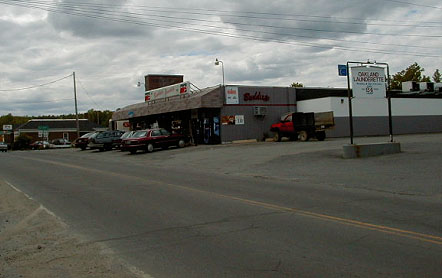
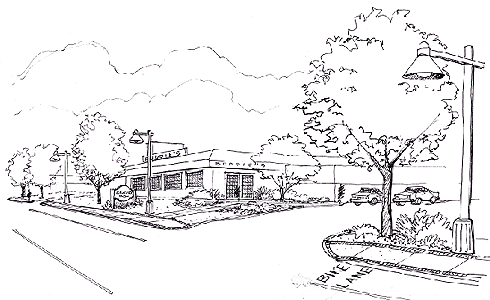
If you look at one existing stretch of street, you see a road, a strip mall, a parking lot, and noplace you'd feel like strolling. A rough sketch here shows the idea of what happens when you don't simply install a sidewalk, but add pedestrian-friendly ambiance to that sidewalk -- including trees to serve as a buffer between walkers and traffic on one side, and getting rid of the parking-lot asphalt in front of buildings on the other side.
That's not a multi-million-dollar project, and they're not re-creating Newbury Street. But it shows how these basic, pedestrian friendly changes create a more desirable downtown.
June 18, 2004

June 17, 2004
‘Slaves To Our Cars’
Development over the past several decades has worked to make our community anything but walkable. It's not just that we're fat and lazy -- we are -- but that our developers have left us stuck in isolated subdivisions. . .
These days, I live only about a mile from where I grew up. But the culture is far different.
My teenage children walk nowhere.
Cheryl Truman is writing in the Lexington (Ky.) Herald-Leader, but she could be talking about a lot of suburbs west of Boston, too. She recalls when she was growing up, and "walked to the grocery store, drugstore, barber and bookmobile, all of which were about a mile away. A city park was about a half-mile away; a school playground offered green space and shade just up the street. A neighborhood pool was only a mile's walk. For distances greater than a mile, we rode bicycles."
And now? Her kids are "delivered by SUV to sports practices, even if those practices are only a mile away. They are chauffeured home from after-school activities. . . . Our family has one bicycle, kept mainly out of guilt; nobody rides it."
Could her kids walk to the store? "Not from where we live. Our tiny subdivision is an isolated cluster of homes with no sidewalk connecting us to any of the other nearby neighborhoods. Walking to the grocery store now would involve crossing an interstate overpass and dodging traffic down a narrow two-lane road."
"So, sure, let's call for a walkable community," Truman concludes. "But let's put some development regulation behind that, and some effort into connecting subdivisions that now exist only as suburban dots in the traffic stream."
June 16, 2004
Revitalization Plans Focus on Pedestrians
A planned $265 million revitalization project in Flushing, N.Y. includes "ways to make the area more pedestrian friendly," the Web site Globe St. reports. "Some improvements will begin this summer to create a distinctive image for the Downtown streetscape and lay the foundation for future enhancements to the pedestrian environment."
That includes turning some streets into one-way thoroughfares and widening sidewalks, not streets.
Flushing is in Queens, one of the five boroughs of New York City.
And, planners in Temple Terrace, near Tampa/St. Petersburg, Florida, are working on a plan to redevelop 230 acres to make the area more appealing both to residents and businesses. They're starting with an old strip mall on 30 acres.
"They're seas of asphalt in front and they're not attractive. There's no greenery, no trees. It's just ho-hum, and businesses are reluctant go into an area like that," Temple Terrace Mayor Fran Barford told St. Petersburg Times columnist Ernest Hooper.
Writes Hooper: "The city has hired Torti Gallas, a urban planning firm based in the Washington, D.C., area. Although the vision is still being formed, it's likely to be a pedestrian-friendly design with parking in the back, a mix of retail and residential, lots of greenery and wide sidewalks. . . .
"We should all hope for success, because many of us live near similar strip malls that cry out for the kind of redevelopment Temple Terrace is embracing."
That includes turning some streets into one-way thoroughfares and widening sidewalks, not streets.
Flushing is in Queens, one of the five boroughs of New York City.
And, planners in Temple Terrace, near Tampa/St. Petersburg, Florida, are working on a plan to redevelop 230 acres to make the area more appealing both to residents and businesses. They're starting with an old strip mall on 30 acres.
"They're seas of asphalt in front and they're not attractive. There's no greenery, no trees. It's just ho-hum, and businesses are reluctant go into an area like that," Temple Terrace Mayor Fran Barford told St. Petersburg Times columnist Ernest Hooper.
Writes Hooper: "The city has hired Torti Gallas, a urban planning firm based in the Washington, D.C., area. Although the vision is still being formed, it's likely to be a pedestrian-friendly design with parking in the back, a mix of retail and residential, lots of greenery and wide sidewalks. . . .
"We should all hope for success, because many of us live near similar strip malls that cry out for the kind of redevelopment Temple Terrace is embracing."
June 15, 2004
Nobscot: Not So Walkable
"The closing of a Nobscot grocery store and the area's lack of sidewalks makes a planned 150-unit, low-income building for senior citizens less appealing, a Zoning Board member said last night," the MetroWest Daily News reports.
"Countryfare Star closed last week and town officials may be called in to help secure land for a sidewalk, making Shillman House a tougher sell for older folks than originally planned, said ZBA member Susan Craighead."
" 'Without sidewalks, things are not within walking distance,' she said. 'It was tough for me to walk (from the planned location to the area shops).' "
I know the ZBA meeting was focused on the JCHE's proposed 150 units of affordable housing, but there's something painfully obvious here that needs to be pointed out: There are already apartments and elderly housing units in Nobscot. The area desperately needs sidewalks, withor without the JCHE units.
Whatever store ends up going in to replace Countryfare Star, that shopping center also could really use a design that makes it more pedestrian-appealing and less for-cars-only.
The same goes for the Pinefield shopping center, by the way, where there is a sidewalk on one side of the street, but to get from the sidewalk to the stores means going through what feels like a mile of asphalt. Why isn't there a halfway appealing walkway from the sidewalk to the shops? There may be a chance to fix this, if a new library building really gets built across the street from the existing McAuliffe branch.
"Countryfare Star closed last week and town officials may be called in to help secure land for a sidewalk, making Shillman House a tougher sell for older folks than originally planned, said ZBA member Susan Craighead."
" 'Without sidewalks, things are not within walking distance,' she said. 'It was tough for me to walk (from the planned location to the area shops).' "
I know the ZBA meeting was focused on the JCHE's proposed 150 units of affordable housing, but there's something painfully obvious here that needs to be pointed out: There are already apartments and elderly housing units in Nobscot. The area desperately needs sidewalks, withor without the JCHE units.
Whatever store ends up going in to replace Countryfare Star, that shopping center also could really use a design that makes it more pedestrian-appealing and less for-cars-only.
The same goes for the Pinefield shopping center, by the way, where there is a sidewalk on one side of the street, but to get from the sidewalk to the stores means going through what feels like a mile of asphalt. Why isn't there a halfway appealing walkway from the sidewalk to the shops? There may be a chance to fix this, if a new library building really gets built across the street from the existing McAuliffe branch.
June 13, 2004
What Does A Smart Growth Suburb Look Like?
Smart Suburbs: A California Community Freed from Car Dependence
"California's booming Silicon Valley is infamous for time spent behind the wheel, but the town of Mountain View decided to make a change. Working with an architect who understood what the community needed, the city and a builder named TPG Development launched The Crossings, a cluster of 300 homes built around a new commuter train station and located within walking distance of shops, offices, and open space," the Natural Resources Defense Council explains.
"The Crossings incorporates two smart-growth elements that free people from their cars: access to public transportation and high-density design. The typical suburban formula of one house per acre stretches the outer limits of towns and adds to residents' commuting time. In contrast, The Crossings has 22 units per acre. Thanks to careful planning, residents say this density does not feel confining, because it is so easy for them to walk to shops, nearby offices, or the train station. They note that the parks, wide sidewalks, lush landscaping, parks, and pleasant streets create a feeling of spaciousness."
Note that every suburb in Silicon Valley isn't going to look like this; there's still plenty of more traditional single-family housing available -- as there should be. But suburbs from Mountain View to Framingham have more densely built areas and more spread-out areas. This offers an alternative for the morse densely zoned areas that doesn't require an auto for a decent quality of life. And it's a big plus for those in more traditional single-family housing who might be within walking distance of that neighborhood's amenities.
You can see images of The Crossings on the Calthorpe Associates Web site.
"California's booming Silicon Valley is infamous for time spent behind the wheel, but the town of Mountain View decided to make a change. Working with an architect who understood what the community needed, the city and a builder named TPG Development launched The Crossings, a cluster of 300 homes built around a new commuter train station and located within walking distance of shops, offices, and open space," the Natural Resources Defense Council explains.
"The Crossings incorporates two smart-growth elements that free people from their cars: access to public transportation and high-density design. The typical suburban formula of one house per acre stretches the outer limits of towns and adds to residents' commuting time. In contrast, The Crossings has 22 units per acre. Thanks to careful planning, residents say this density does not feel confining, because it is so easy for them to walk to shops, nearby offices, or the train station. They note that the parks, wide sidewalks, lush landscaping, parks, and pleasant streets create a feeling of spaciousness."
Note that every suburb in Silicon Valley isn't going to look like this; there's still plenty of more traditional single-family housing available -- as there should be. But suburbs from Mountain View to Framingham have more densely built areas and more spread-out areas. This offers an alternative for the morse densely zoned areas that doesn't require an auto for a decent quality of life. And it's a big plus for those in more traditional single-family housing who might be within walking distance of that neighborhood's amenities.
You can see images of The Crossings on the Calthorpe Associates Web site.
Subscribe to:
Posts (Atom)